A Report About You

A report about you. Not about people like you.

ALIS doesn't score your answers against a crowd. It simulates you, measures what comes out, and writes it up in plain language. Here's what's in it.
1Your ten Characteristics

Your ten Characteristics

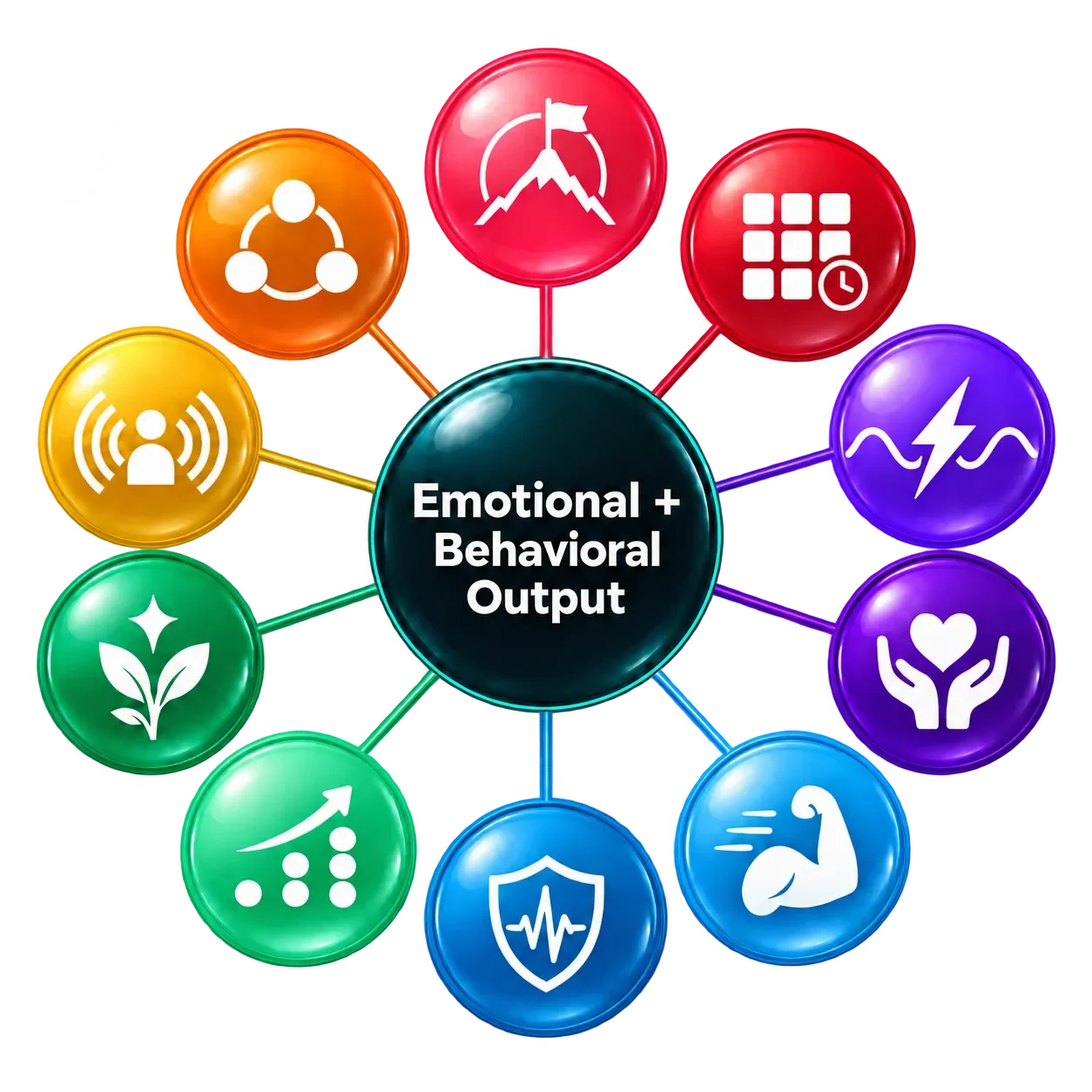
The ten ALIS Characteristics arranged in a ring around Emotional and Behavioral Output

Tap a Characteristic to read about it.

How to read each Characteristic
  1. Characteristic Context

    What part of your life this Characteristic covers. It reflects how you were on the day you took the assessment — not who you are permanently. People change, and ALIS shows how and when.

  2. Emotional & Behavioral output

    Which emotions and behaviors will show up, when, and how you'll feel about them. Remorse, Fear, Filtering, and Saturation appear only when calculated — not for everyone.

  3. Drivers & Tolerance Windows

    The cardinal drivers, tolerance windows, and conditions behind the result. Change the conditions, and the result changes.

  4. Perception & Conflict

    How you see others, how they see you, and where Response Zones create conflict. Self-awareness and filtered self-information are flagged when present.

  5. Practical interpretation

    What it all means for your leadership, communication, learning, conflict style, risks, pitfalls, and room to grow.

2Integrated prediction

What Does ALIS Predict?

The Characteristic sections explain the pieces. This section shows how they work together.

Emotional and Behavioral Manifestations

By mapping out your full range of emotions and behaviors, you can determine the Cardinal Drivers behind your automatic responses, the triggers for your deliberate decisions, and how both play out in real time.

Individual Perception and Interaction

ALIS can show you how you see and interact with others across every Characteristic. When you add other people's data, it shows where Response Zones create alignment or friction, how those dynamics will unfold, and what to adjust to work together better.

Development, Leadership, and Impact

Empowered with ALIS, you can track your emotional development over time, highlight your leadership strengths, flag your pitfalls, and take specific steps to keep stress from spilling onto the people around you.

Individualized by design

ALIS never relies on broad personas, fixed categories, or simply mirroring your answers back. It runs your inputs through geometric algorithms to build a live simulation of your own behavioral and emotional architecture.

  • Computational precision: Instead of reflecting what you reported, ALIS maps how your tolerance windows actually interact.
  • Self-perception driven: Insights that feel obvious are the areas you already see clearly. The ones that surprise you sit in your filtering or saturation ranges.
  • Predictive mapping: Models your Cardinal Drivers, automatic triggers, conflict responses, and leadership style as real-world conditions shift.

Every calculation, insight, and trajectory in your report belongs to your own model at that moment in time.

3The questions you actually want answered

The questions you actually want answered

Leadership

How you direct, judge, decide, and affect other people — and when it works.
Communication

How you express and receive information, and what creates clarity or misunderstanding.

Learning

How you take in, organize, retain, and apply information.

Conflict

Where friction starts for you, how it shows, and what changes the outcome.

Risk

Emotional, behavioral, and interpersonal risks, stated without generic labels.

What drives you

The highest-order conditions behind your automatic behavior.

Pitfalls and growth

Where you get stuck, and where the room is.

How you're seen

How you view others and how they're likely to experience you.

4Your action plan

Your action plan

Small, specific actions chosen for their calculated effect on you.
  1. The output to address

    The behavior that's costing you, and when it shows up.

  2. Individual or group impact

    You, the people around you, the group you're in.

  3. The micro-adjustment

    A small, specific action chosen for its calculated effect on you, not because it's "healthy."

  4. The observable change

    What you should expect to see if you do it.

  5. Reassess

    Retake weekly to track what moved.

  6. Long-term tracking

    Repeated over time, it tracks your progress, regression, outside pressures, and ongoing relationships.

5From self-discovery to healing

From self-discovery to healing

ALIS can be taken and used on its own: to understand yourself, for fun, for self-help, or to overlay your map with a partner, a friend, or a coworker and see how the two of you actually work. Employers, schools, or any teams use it to screen new additions that fit. In clinical use, alongside a therapist, ALIS does its most important work. It is not a replacement for therapy. Used with a therapist, it can speed up the time until a person begins to see healing and results. ALIS can see trauma without the person having to relive the experience by telling the story — giving insights that would otherwise remain unseen or take extended periods to uncover. The same is true for other mental health issues: ALIS can see them, and the patterns behind them, giving a therapist a clear starting point from the first session.
6Private by design

Private by design

Encrypted, never used for advertising, never sold.
You can permanently detach your data from anything that identifies you.
Reports contain only what you asked for.
HomeAI Consultant